New to Crypto Options? Here are Four Things You Should Keep in Mind

Crypto derivatives offer unique opportunities to traders while allowing them to speculate on the future price fluctuations of the underlying crypto asset in a derivatives contract with limited risks. Derivatives trading, earlier, had been the realm of institutional investors. But with the emergence of tailored and automated derivatives trading products and strategies, such as those provided by Delta Exchange, retail investments in options trading have been on the rise. The exchange has been witnessing an increase in traders’ interest and trading volumes in options trading, especially those of Solana (SOL) and Binance (BNB). For the uninitiated, options trading might seem a grueling task, but once you understand the basics of what an option is and how it works, things start turning from bleak to bright. Before we get on with fine-tuning your options trading strategies, let’s have a quick revision of what options trading constitutes.
- Options are a kind of derivatives contract where traders can speculate on the future price of an underlying asset.
- The traders are given ‘the right’ but aren’t under any ‘obligation’ to sell the underlying asset at a set price at or before the predetermined expiration date.
- There are two kinds of options: call options and put options. Call options give the trader the right to buy the underlying asset at a set price on the expiration date, while a put option gives the trader the right to sell the underlying asset at a set price on the expiration date.
- Crypto options are a relatively cost-effective and less risky derivatives solution for trading cryptocurrencies than futures or perpetual swaps.
- The cost of an option is called a premium. The price of a premium is dependent on the time remaining on the contract, implied volatility, interest rates, and the current price of the asset underlying the contract. Premium can also be considered the predefined risk or the maximum loss that a trader has to bear while buying options.
- The strike price is the price at which the trader has the right under the contract to buy or sell the underlying asset on the expiration date.
- Options can be settled either in USD or stable cryptocurrencies like USDT.
If you are a trader getting started with options trading, here are some quick tips for you that will surely help you chart a clearer trading route in the derivatives market:
#1 DYOR: Effect of Bear and Bull markets
Predicting future prices requires knowledge, creativity, and wisdom on part of the derivatives trader, especially in the volatile crypto markets. It is pertinent that you do your own research in the crypto derivatives market before trying out your luck. The strategies used in options trading differ from that of spot trading. Options trading is time-sensitive and is impacted by the volatility prevalent in the market. Acquaint yourself with market conditions, the kind of options contracts available, and decide on what kind would be preferable to you in a bullish or bearish market. There can be four basic case scenarios here:
- The long Call: When a trader believes the market sentiment (the underlying asset’s price going up) to be bullish, they buy a call option. Here the potential profit is determined by the current price of the underlying crypto asset over the strike price and the premium paid for the option.
- The Short Put: When a trader believes the market sentiment to be bullish, they sell a put option. If the asset’s current price is greater than the option’s strike price, the buyers of the option will choose not to sell, and the option writer profits from the premium.
- The long Put: When a trader believes the market sentiment to be bearish (the underlying asset’s price is going down), they buy a put option. Here, the buyers buying a put option will benefit if the underlying asset’s current price is below the strike price by a greater amount than the premium on the contract.
- The Short Call: When traders believe the market sentiment to be bearish, they write or sell a call option. This strategy is used as a part of the covered call strategy. Under this strategy, the buyer collects the premium on the option and chooses not to exercise their option when the current price of the underlying asset is lower than the strike price.
Options, being purely speculative instruments, do not yield returns in isolation. They need to be a part of the broader strategy in any derivatives trading portfolio. For that, a few more DYOR-related pointers that you can keep in mind include:
- Learn how options trading works, the related terms, and the prevalent norms in the market.
- Keep a tab on the spot trading price of the underlying asset as the current price of that asset plays a significant role in determining how much the premium in an options contract costs.
- You need to have an accurate and timebound view of your trading bet to decide on the expiry date and strike price.
#2 Implied Volatility: Meaning and Impact
Implied Volatility is the expected standard deviation of the underlying asset’s price during the contract’s start and end date. The higher the volatility in the underlying asset, the more profitable and expensive an options contract becomes. Conversely, options with lower market demand mean lower implied volatility, resulting in cheaper option contracts. The implied volatility inherent in any options contract will determine the time value ( the additional premium priced into an option representing the amount of time left until expiration) and, consequently, the success of an options contract. Now, a trader needs to understand that every options contract attaches a unique sensitivity to implied volatility changes:
- Short-dated options will be less sensitive to IV than long-dated options contracts for the simple reason that long-dated options will have more intrinsic time value as opposed to short-dated contracts.
- Strike price also responds differently to implied volatility changes depending on how near it is to the underlying asset’s current price. When the strike price is nearer to the current price of the underlying asset, it is more sensitive to implied volatility and vice versa.
- Traders buy options, whether call, put, long straddles, or debit spreads, when the implied volatility is low. They sell options and consider strategies such as covered calls, naked puts, short straddles, and credit spreads when the implied volatility is relatively high. Checkout this guide on best options trading strategies.
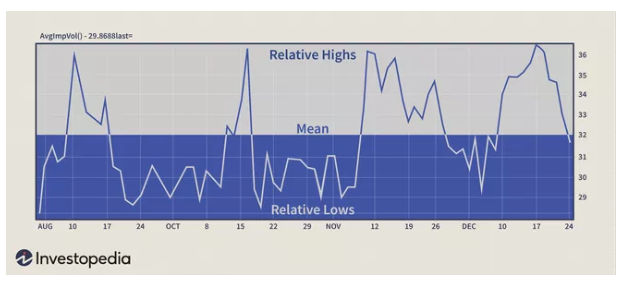
Traders can analyze charts that provide an average view of the implied volatility of the options contract. The relative highs and lows, or peaks and troughs in the underlying asset’s current price are when the IV is high and low. You must remember that IV moves in cycles with high volatility periods often followed by low volatility periods. Hence, you should always use relative implied volatility ranges combined with forecasting techniques to help you select the best options contract.
Source: Investopedia
Betting on whether the prices will increase or decrease is a major element in options trading. Invest in options only when you think the market will face volatility in the coming days. If the market is stuck in a familiar range, avoid investing in options.
#3 Time Decay: Impact on Call and Put Options
Time decay refers to the natural reduction in the price of an option as its expiration date approaches. The prices may decrease till the point an option expires worthless. It is the most significant factor in determining option prices. Being an inevitable price decrease, traders need to be wary of time decay when trading in options both in the short term and long term. Time decay is dependent on three factors, namely,
- Volatility
- Time remaining until expiration, and
- Interest rates
While most traders are aware of time decay, they don’t realize that time value depletes in the reverse fashion, i.e., as the expiry date gets nearer, time value increases in response to the increasing probability of the option reaching its strike price before the expiration date. For call options, time decay affects the call price negatively, but for put options, time decay has a positive impact on the put price. If you are a beginner in options trading, don’t overlook time decay as a factor as its effect on the options prices isn’t immediate. Time decay is more conspicuous in short-term options and impacts traders who hold long positions the worst. As such, traders need to continually realign their trading strategies to avoid losses due to time decay.
#4 Choosing a Good Exchange
The choice of derivatives exchange to start your options trading journey is, to some extent, a matter of personal choices and expectations. However, here are some parameters that could help you choose the right derivatives exchange:
- Cryptocurrency exchange with multiple security layers is necessary for safeguarding your funds, assets, and personal data.
- A well-capitalized insurance fund helps protect the traders from adverse ‘socialized losses,’ i.e., a situation where the profits from profitable traders are used to cover the losses of some insolvent traders on the platform.
- A high-performance, powerful matching engine impacts traders’ experience on the platform and is the necessary infrastructure to introduce new order types and trading pairs.
- A derivatives platform with high liquidity and trading volumes means lesser risks and lower transaction costs for the users.
- A wide selection of derivatives products accompanied by sufficient leverage ensures optimal derivatives trading for any trader.
- Lower trading fees- maker or taker fees - on any derivatives exchange is another marker for choosing one exchange over the other.
Delta Exchange ticks all the prerequisites for the best derivatives exchange, given its broad range of innovative derivatives products on over 60 altcoins with up to 100x leverage. Its enterprise-grade, multi-factor security, and manual review system ensure optimum security for traders. The powerful matching engine with intuitive user interface, advanced order types, and lightning-fast APIs commend it the status of a truly premier derivatives exchange. Looking to kickstart your options trading journey? Sign-up on Delta Exchange to get started!
Frequently Asked Questions (FAQs)
Q1: What are crypto options and how do they work for beginners?
Answer: A crypto option gives the buyer the right, not obligation, to buy (call) or sell (put) a cryptocurrency at a fixed strike price before expiry. The buyer pays a premium; no full capital commitment is required.
Q2: How does implied volatility affect the pricing of crypto options contracts?
Answer: Implied volatility (IV) reflects the market's expected price swings and directly inflates or compresses premiums. High IV benefits sellers; low IV favours buyers. Crypto IV spikes sharply around halvings, ETF approvals, and major regulatory events.
Q3: What is time decay in options trading and how does it impact call and put options?
Answer: Time decay (theta) erodes an option's extrinsic value daily, accelerating in the final 30 days before expiry. Buyers lose value when price stays flat; sellers collect it - making short-dated options writing viable in range-bound markets.
Q4: How do bull and bear market conditions influence options trading strategies?
Answer: Bull markets favour buying calls or selling puts for premium income. Bear markets suit buying puts or writing covered calls. Sideways, high-IV environments work well for spread strategies like iron condors that profit from volatility mean-reversion.
Q5: What are the key factors to consider when choosing a crypto derivatives exchange for options trading?
Answer: Prioritise liquidity, strike/expiry range, settlement currency, fees, and risk tooling. Delta Exchange provides BTC and ETH options with INR settlement, a built-in Strategy Builder for multi-leg positions, and FIU registration for Indian derivatives traders.