
Digital Derivatives – Why Paul Tudor is Long Bitcoin

Digital Derivatives is a weekly newsletter bringing you the latest research, information and analytics from the cryptocurrency derivatives space brought to you by Delta Exchange. For last week's edition, click here.
Market Moves
Derivatives Insights
Billion Dollar Hedge Fund is Long BTC
If you haven’t heard by now, Paul Tudor Jones - who manages the ~$8bn hedge fund Tudor Investment Corporation - is long bitcoin. Last week, Mr. Tudor revealed that his fund has allocated ~1-2% of the fund’s capital to a long Bitcoin futures position. It is a safe assumption that this position has been taken in the Bitcoin Futures trading on CME, and the trading activity of this futures contract is a good proxy for institutional investors’ interest in cryptocurrencies. As things stand today, CME bitcoin futures monthly trading volume is $6.78B and open interest is at a record high of $529 million. Compare this to BitMex’s BTC Perpetual contract: Monthly trading volume = $77.12B and current open interest = 57.69k BTC ($554 million). It is interesting to note that Open Interest at CME’s Bitcoin futures has come pretty close to that of BitMEx.
Why Paul Tudor likes Bitcoin
Paul Tudor sees Bitcoin as a strong inflation hedge. The ongoing ‘Great Monetary Inflation’ in which central banks around the world are printing money has significantly increased the risks of hyperinflation in the future. With growing economic uncertainty and unprecedented levels of global debt, the importance of an effective store of value has never been more evident.
Tudor sees Bitcoin as this store of value. A store of value asset is “anything which holds its purchasing power in the long run.” It is a function of psychology, with a value based on people’s perception of the assets worth, with both tulips, fiat, gold and Bitcoin functioning as stores of value at one time. The effectiveness of a store of value asset can be ranked across 4 dimensions:
- Purchasing Power - Is asset value maintained over time?
- Trustworthiness - How is the asset universally perceived?
- Liquidity - Can it be exchanged into a transactional asset?
- Portability - Can the asset be geographically moved?
The Tudor team compared Bitcoin against the following assets - financial assets, cash, gold - and assigned them subjective scores. Below is their analysis:
- Purchasing Power: One argument to address is the need for a financial yield to defeat inflation - a consistent return above the inflation rate. If the emphasis is on this, the clear (and only) winner is financial assets. However, Tudor notes the double-digit inflation rates of the 1970’s with financial assets unable to keep up. Another angle to address is that of scarcity. Bitcoin is the only asset analysed with clear fixed maximum supply built into its system. Roughly 10% of the total available Bitcoin are left to be mined, with roughly 18.5m circulating out of a total of 21m. With the rate of newly issued BTC slowing down gradually, Bitcoin is a truly unique asset.
- Trustworthiness: To nobody’s (and everybody’s) surprise, Bitcoin scored the lowest here. As the youngest entrant, Bitcoin has a lot of work to do to convince investors of its trustworthiness as an asset. However, with +60m users across 200 countries, a transparent foundation and an algorithmically fixed supply rate, arguments could be made for the opposite. Gold happened to score the highest here, standing the test of time for thousands of years.
- Liquidity: The case for Bitcoin here is its 24/7 tradable nature. It is the only observed asset which can be traded at all times. Cash otherwise scored the highest in this category - and rightfully so - with Bitcoin, financial assets and gold following suit.
- Portability: Portability is, like liquidity, irrelevant until it isn’t. Here, the asset must be transferable across borders with minimal hassle and costs. Cash is decent, but realistically gets difficult to manage as the amount grows. This is similar to gold - difficult to transfer above a certain threshold. Bitcoin is the clear winner here, with billions of dollars worth of the asset capable of being stored on a ledger the size of a USB stick.
What’s The Verdict?
| Asset | Subjective Score |
| Financial Assets | 71 |
| Gold | 62 |
| Fiat Cash | 54 |
| Bitcoin | 43 |
Assets ranked according to Tudor, To few people’s surprise, Bitcoin came last. It is unproven with only 10 years to its name.
However, that wasn’t the interesting part. What is worth noting is the ultimate ranking of Bitcoin relative to its peers.
- Bitcoin had a score of 60% of that of financial assets, with a market cap that is 1/1200th of financial assets.
- Bitcoin had a score of 66% of that of gold, with a market cap that is 1/60th of gold.
- Bitcoin had a score of 79% of that of cash, with a (proxy) market cap that is 0.46% of cash.
Tudor sees Bitcoin price as an outlier. His key argument for Bitcoin here is the quantity of people who can own the asset who do not currently own it. Virtual currency wallets are becoming increasingly commonplace throughout the world and this will only grow as Facebook introduces Libra and China introduces their DCEP. This makes Bitcoin more commonplace and easy-to-use day by day.The key thing that is unique to Bitcoin - compared to almost all other assets on this planet - is its removal of the need for trust. Bitcoin is an open-source network built upon a transparent ledger system with a fixed supply rate. There will be no unexpected printing or debasing, no downtimes, no access restrictions. There is no need for the trust which we place in central banks and governments to maintain current currency systems.
Bitcoin as compared to Gold
Tudor believes that the Bitcoin ecosystem today is where Gold was in 1976. At the time, Gold had just been made into a futures instrument (as is the case with Bitcoin) and enjoyed tremendous price volatility. Gold went on to quadruple over the next 3 years - between 1977 and 1980 - as its role as an inflation hedge grew. The red line in the graph below is where Paul Tudor thinks the price of Bitcoin may be today.
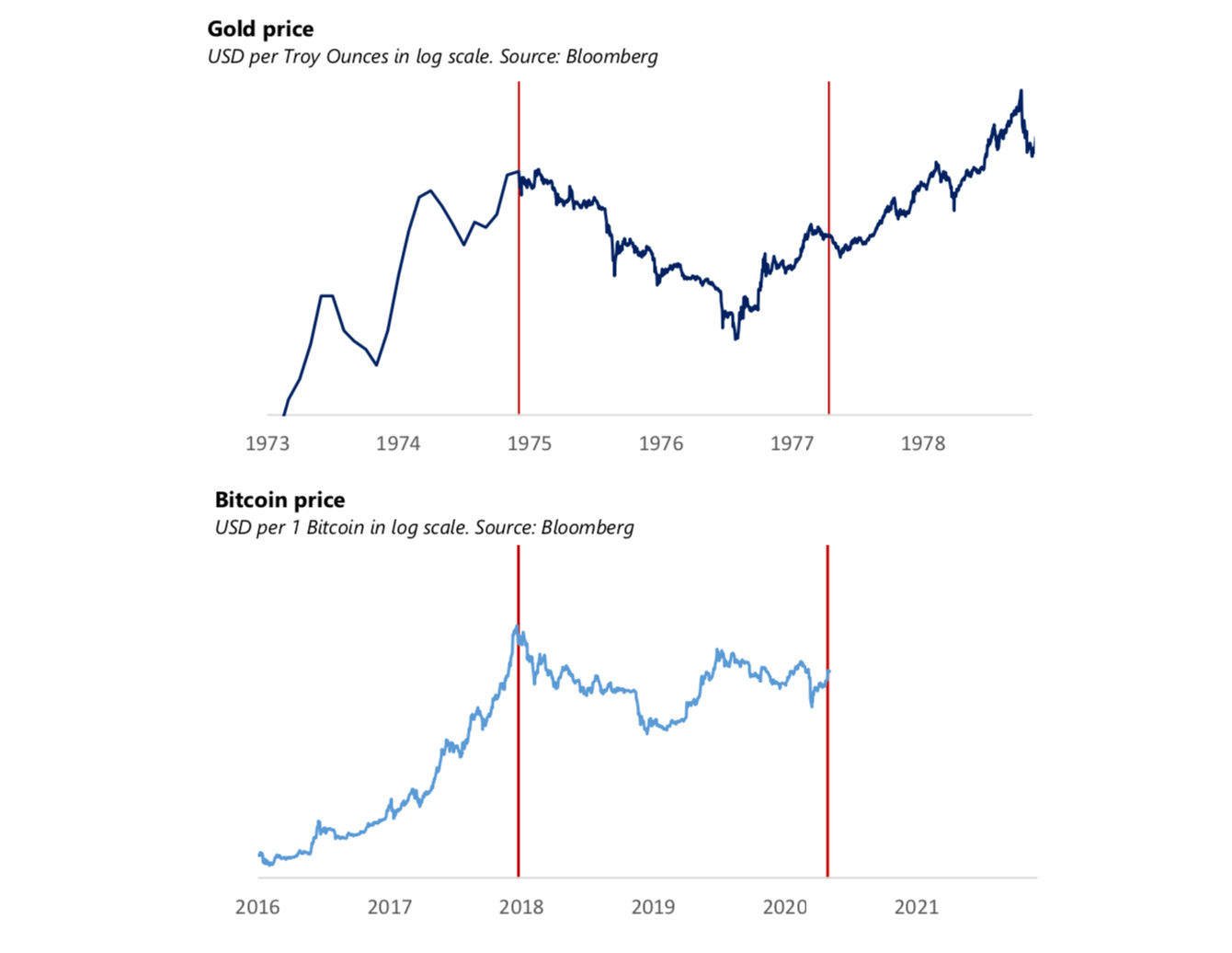
So, what’s to come? CME Bitcoin Futures have seen 567 new accounts start trading their contracts in the first quarter of 2020, which is more than double the amount of Q4 2019. Meanwhile, the Open Interest in the market has reached an all-time high with 66 new “large traders” (traders with positions exceeding 25 BTC).In addition to Jones, Renaissance Technologies – a $75 billion US-based hedge fund - has made clear that its funds are now "permitted to enter into bitcoin futures transactions” via CME. Open interest across CME Bitcoin markets from hedge funds has additionally hit a 10-month high, according to data compiled by The Block, hitting $150 million on May 5. “The best profit-maximizing strategy is to own the fastest horse. If I am forced to forecast, my bet is it will be Bitcoin.”
Delta Developments
The Delta Podcast Is Here!
We're proud to announce the launch of our Delta Podcast series! 🎤
In our first episode, Delta co-founder Pankaj Balani discusses everything from cryptocurrency derivatives to traditional financial markets, and the effects of the global COVID19 pandemic with members of the Whalepool team. Full listen here!
Frequently Asked Questions (FAQ)
Q1: Why did Paul Tudor Jones go long Bitcoin?
Answer: Paul Tudor Jones allocated roughly 1-2% of his fund to Bitcoin in 2020 as a macro hedge against currency debasement from unprecedented money printing. Since then, institutional conviction has grown considerably, culminating in US spot Bitcoin ETF approvals in January 2024.
Q2: What makes Bitcoin a store of value?
Answer: Bitcoin's fixed 21 million supply, decentralisation, and censorship resistance give it properties similar to digital gold. Unlike fiat currencies, it cannot be inflated by central banks, a thesis that gained credibility during the multi-decade high inflation environment of 2022 and beyond.
Q3: How does Bitcoin compare to gold as a store of value?
Answer: Gold carries millennia of trust, but Bitcoin offers superior portability, divisibility, and verifiability. Gold's market cap sits around 20 trillion dollars, while Bitcoin's remains a fraction of that, suggesting room to grow if institutional adoption through vehicles like spot ETFs continues at its current pace.
Q4: Why does Bitcoin's fixed supply matter for investors?
Answer: Bitcoin's 21 million cap means supply cannot respond to demand the way commodities or fiat can. The April 2024 halving cut new issuance to 3.125 BTC per block, and post-halving annual inflation is now below 1%, tightening supply further as institutional demand grows.
Q5: How portable is Bitcoin compared to traditional assets?
Answer: Bitcoin can be transferred globally in minutes with just a private key, requiring no vaults or custodians. This portability is a structural advantage over gold or real estate, particularly for cross-border capital movement, and is one reason institutional treasuries find it attractive as a reserve asset.
Q6: How has institutional Bitcoin adoption grown since 2020?
Answer: Substantially. BlackRock's iShares Bitcoin ETF holds roughly 67 billion dollars in AUM as of May 2026, and Strategy holds over 840,000 BTC on its corporate balance sheet. Spot ETF cumulative inflows have crossed 58 billion dollars since approval in January 2024.
Q7: Are hedge funds and institutions investing in Bitcoin derivatives?
Answer: Yes, institutional participation via CME Bitcoin futures and US spot ETFs has grown significantly since 2024. On Delta Exchange, traders can access BTC futures and perpetual contracts with INR settlement, making institutional-style Bitcoin positioning accessible to Indian market participants.